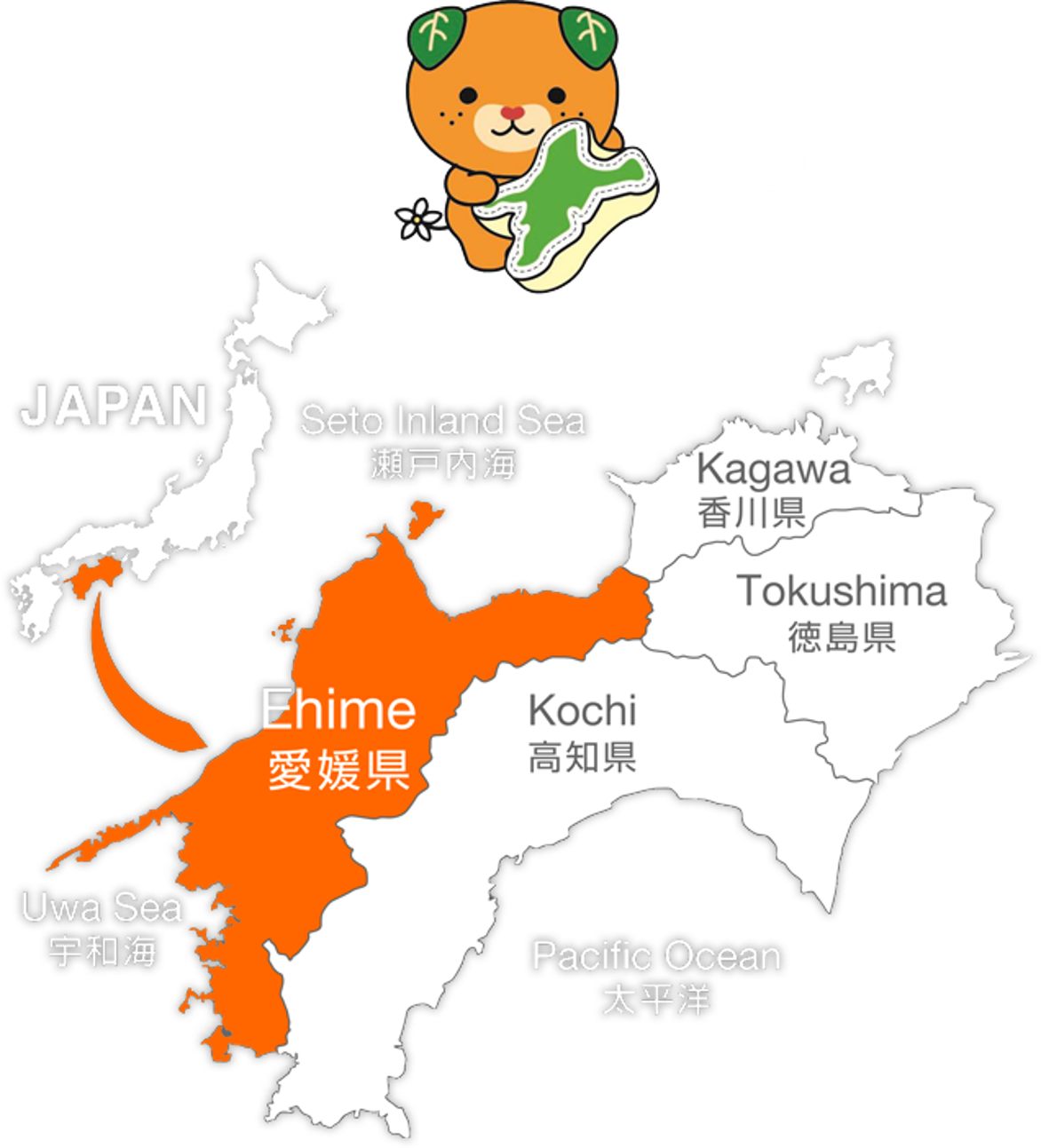
Ehime Prefecture (愛媛県, Ehime-ken) is a prefecture of Japan located on the island of Shikoku. Ehime Prefecture has a population of 1,334,841 and a geographic area of 5,676 km2 (2,191 sq mi). Ehime Prefecture borders Kagawa Prefecture to the northeast, Tokushima Prefecture to the east, and Kōchi Prefecture to the southeast.
Matsuyama is the capital and largest city of Ehime Prefecture and the largest city on Shikoku, with other major cities including Imabari, Niihama, and Saijō.
Notable past Ehime residents include three Nobel Prize winners: they are Kenzaburo Oe (1994 Nobel Prize in Literature), Shuji Nakamura (2014 Nobel Prize in Physics), and Syukuro Manabe (2021 Nobel Prize in Physics).
History
Until the Meiji Restoration, Ehime Prefecture was known as Iyo Province. Since before the Heian period, the area was dominated by fishermen and sailors who played an important role in defending Japan against pirates and Mongolian invasions.
After the Battle of Sekigahara, the Tokugawa shōgun gave the area to his allies, including Katō Yoshiaki who built Matsuyama Castle, forming the basis for the modern city of Matsuyama.
The name Ehime comes from the kuniumi part of the Kojiki where Iyo Province is mythologically named Ehime, "lovely princess".
In 2012, a research group from the University of Tokyo and Ehime University said they had discovered rare earth deposits in Matsuyama.
Geography
Located in the northwestern part of Shikoku, Ehime faces the Seto Inland Sea to the north and is bordered by Kagawa and Tokushima in the east and Kōchi in the south.
The prefecture includes both high mountains in the inland region and a long coastline, with many islands in the Seto Inland Sea. The westernmost arm of Ehime, the Sadamisaki Peninsula, is the narrowest peninsula in Japan.
As of 31 March 2020, 7 percent of the total land area of the prefecture was designated as Natural Parks, namely the Ashizuri-Uwakai and Setonaikai National Parks; Ishizuchi Quasi-National Park; and Hijikawa, Kinshako, Okudōgo Tamagawa, Sadamisaki Hantō-Uwakai, Saragamine Renpō, Sasayama, and Shikoku Karst Prefectural Natural Parks.
Cities
Eleven cities are located in Ehime Prefecture:
Towns and villages
These are the towns in each district:
Mergers
Former districts:
- Onsen District
- Shūsō District
- Uma District
- Uwa District (historical)
Economy
The coastal areas around Imabari and Saijō host a number of industries, including dockyards of Japan's largest shipbuilder, Imabari Shipbuilding. Chemical industries, oil refining, paper and cotton textile products also are a feature of the prefecture. Rural areas mostly engage in agricultural and fishing industries, and are particularly known for citrus fruits such as mikan (mandarin orange), iyokan and cultured pearls.
Ikata Nuclear Power Plant produces a large portion of Shikoku Electric Power.
Education
Sports
The sports teams listed below are based in Ehime.
Association football:
- Ehime FC
- FC Imabari
Baseball:
- Ehime Mandarin Pirates
Basketball:
- Ehime Orange Vikings
Culture
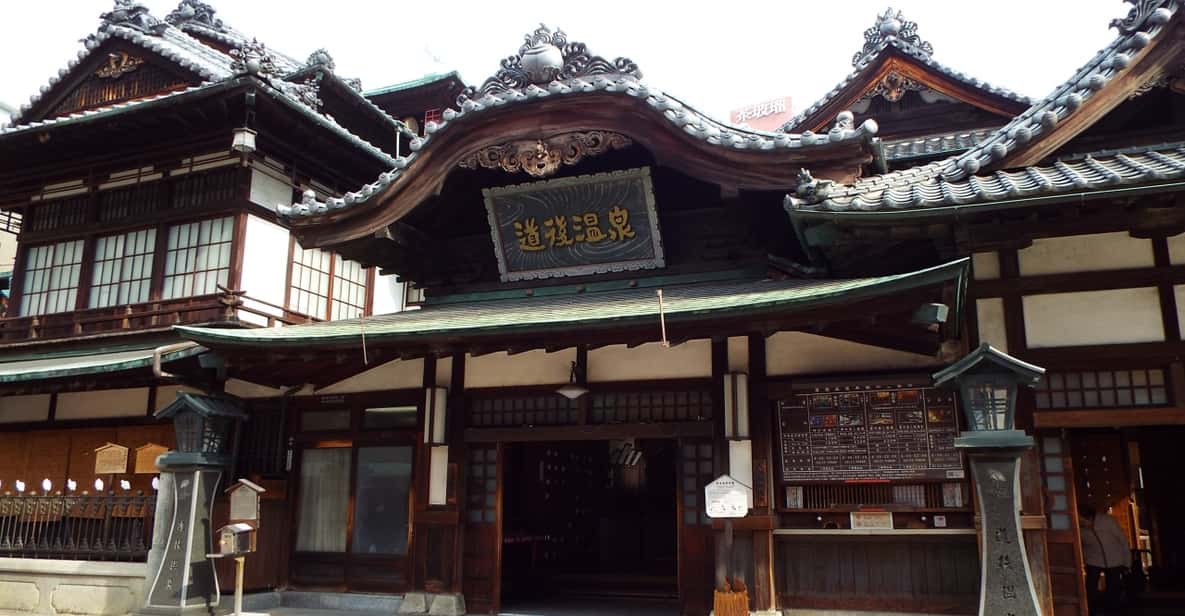
The oldest extant hot spring in Japan, Dōgo Onsen, is located in Matsuyama. It has been used for over two thousand years.
These are television shows and movies set in Ehime Prefecture.
- Tokyo Love Story is a story with characters are from Ehime Prefecture. Therefore, a lot of shooting was done in Ehime. Baishinji Station is famous for being filmed.
- Shodō Girls was made based on the true story of a high school student in Shikokuchūō. A member of the calligraphy club began doing Performance calligraphy at shopping malls and events to liven up the local region. After that, the Shodō Performance Koshien (書道パフォーマンス甲子園) was held in 2008.
- Botchan is a novel written by Natsume Sōseki. It was based on his experience in Matsuyama. Movies, dramas, and manga are published based on the novel. Botchan Ressha and Botchan Stadium are associated with this.
- Saka no Ue no Kumo is written by Ryōtarō Shiba. The main characters are Akiyama Yoshifuru, Akiyama Saneyuki and Masaoka Shiki, all of whom are from Ehime prefecture. It was broadcast on NHK as a TV drama.
- Koi wa Go・Hichi・Go! (恋は五・七・五!) is set in Haiku Koshien, which is actually performed. The shooting was done at a high school, university, and library in Ehime. The haiku of this movie was supervised by Itsuki Natsui, haiku poet from Ehime.
- Destruction Babies (ディストラクション・ベイビーズ) is set in Ehime. This movie was made based on the true story that the director head from a person he met when he visited Matsuyama. The director won an award at the Locarno Festival in 2016, and the film was selected as semi-grand prix at the Three Continents Festival in 2016.
- My-HiME is set in Ehime.
There are major festivals in Ehime Prefecture.
- Uwajima Ushi-oni Festival is held for three days, with a parade of many Ushi-oni walking around the city, a traditional Uwajima dance, a fireworks display, and a run on the final day.
- Niihama Taiko Festival is the autumn festival in Niihama. The drum stand is lifted by about 150 men. It is one of the three biggest fight festivals in Japan.
- The Matsuyama Autumn Festival includes a mikoshi event called Hachiawase (鉢合わせ) which takes place near Dōgo Onsen and Isaniwa Shrine.
Hot springs
These are several hot springs (onsen) in Ehime Prefecture.
- Dōgo Onsen appears in the Nihon Shoki. This Hot Spring has three public baths: the main building, Tsubaki no Yu, and Asuka no Yu.
- Sora to Mori is a combined warm bath facility. There are hot springs, restaurants, and body care.
- Nibukawa Onsen is a hot spring located in Imabari. The source originates from the crevices of the Inugawa Valley in this hot spring town.
Language
Iyo dialect is a Japanese dialect spoken in Ehime Prefecture. Nanyo is influenced by the Kyushu dialect, and Chuyo and Toyo are influenced by the Kinki dialect.
Museums
- Kaimei School
- Museum of Ehime History and Culture
Transport
Notable people
- Naoki Kuwata (born 1977), actor and model
- Tetchō Suehiro (born 1849), politician, novelist and journalist
International relations
Ehime Prefecture is making use of its long tradition of involvement with people overseas through international exchanges in areas such as the economy, culture, sports and education.
- British Columbia, Canada
- Dalian, China
- Hawaii, United States
- Liaoning, China
- New South Wales, Australia
- Queensland, Australia
Notes
References
- Nussbaum, Louis-Frédéric and Käthe Roth. (2005). Japan encyclopedia. Cambridge: Harvard University Press. ISBN 978-0-674-01753-5; OCLC 58053128
External links
- Official website